
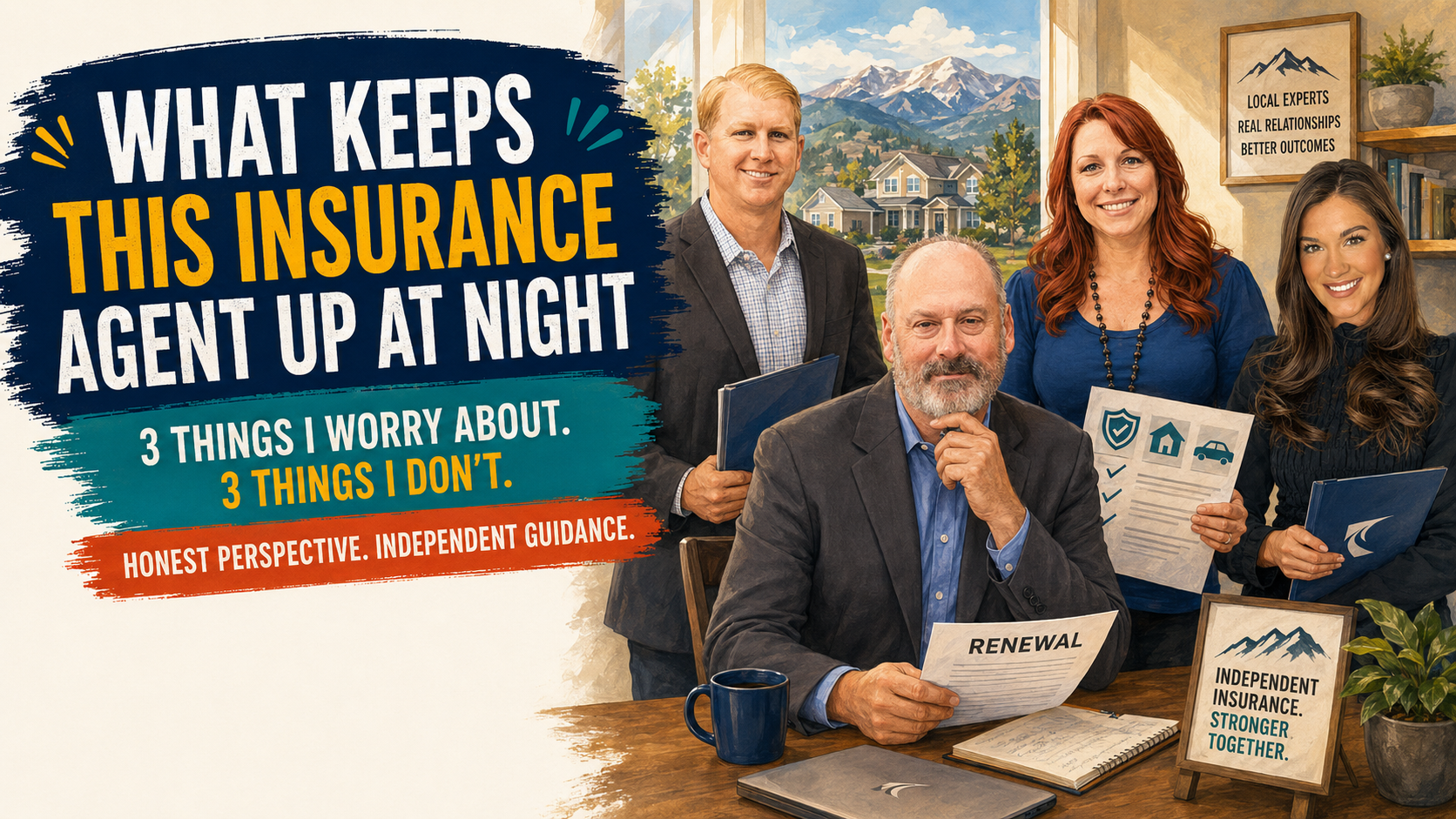
Owning a small, local insurance agency gives you a front-row seat to a market most consumers experience only once or twice a year—usually when a renewal arrives with an unpleasant surprise.
We see the premium increases. We see insurance companies tighten their underwriting requirements. We see responsible homeowners struggle because of an aging roof, a wildfire score, a change in deductible, or something detected in an aerial photograph. We also see families trying to balance appropriate protection against mortgages, groceries, car payments, and just about every other expense that has become more expensive.
After more than 25 years in insurance, I have learned that there are things worth worrying about—and plenty of things that probably receive more worry than they deserve.
Here are three things that genuinely concern me about today’s insurance market, followed by three things I am not losing sleep over.
Three Things I Worry About
1. Good customers being treated like bad risks
This may be one of the most frustrating parts of the current insurance market. A customer can do everything we traditionally consider “right.” They can maintain their home, pay their premiums on time, bundle their home and auto insurance, avoid unnecessary claims, and remain loyal to the same insurance company for years. Then the renewal arrives with another increase—or, in some cases, a nonrenewal.
Understandably, the customer wants to know what they did wrong. The honest answer is often: nothing.
Insurance has always been based on sharing risk among many people. Today, however, pricing and underwriting depend heavily on broad data: property characteristics, geographic models, roof age, aerial imagery, weather patterns, wildfire exposure, reconstruction costs, claim trends, and an insurance company’s overall results in a particular area.
That means a cautious, claim-free homeowner can still be affected by losses occurring throughout Colorado and by larger trends well beyond the customer’s control. A roof may not leak and may appear perfectly serviceable, but its age alone can reduce the number of companies willing to insure it. A home may never have had a hail claim, but it is still located in a state where hail losses are frequent and expensive.
From the insurance company’s perspective, these decisions are based on measurable risk and the need to collect enough premium to pay future claims. From the customer’s perspective, it can feel as though years of responsible behavior and loyalty suddenly mean very little.
Both perspectives can contain some truth.
I understand the frustration personally because I am not only an insurance agent—I am also an insurance customer.
I own a home. My children are grown and no longer living at home or driving my vehicles. I live in an area that would probably be considered relatively low risk for hail compared with many parts of Colorado. My vehicles are older, and I am properly insured at rates I still consider good overall.
Yet my premiums continue to increase too.
I open my renewal documents and see many of the same increases our customers see. Understanding the insurance market does not mean I enjoy paying more for my home and auto insurance. I have a household budget like everyone else, and an increase is still an increase—even when I understand some of the reasons behind it.
That perspective reminds me that our customers are not necessarily frustrated because they do not understand insurance. Sometimes they understand the explanation perfectly well and are still unhappy with the result. That is entirely reasonable.
But when my own rates increase, does that mean my staff or I should automatically shop all of my insurance with every company we represent?
Not necessarily.
An increase should get our attention, but it does not automatically mean the current policy is no longer a good value. We still need to consider the entire picture: coverage, deductibles, discounts, roof settlement provisions, the stability of the insurance company, and what might be lost by moving.
Another company may offer a lower premium, but will the coverage be comparable? Will the new company view the roof differently? Will it require a new inspection? Will the wind and hail deductible be higher? Will moving the home policy cause the auto premium to increase? Are the savings meaningful enough to justify the change, or are we simply moving from one increasing company to another?
Sometimes shopping confirms that a better option exists. Other times it confirms that the policy already in place remains the best overall choice—even if nobody particularly likes the new price.
We should not confuse “my premium increased” with “my policy is no longer competitive.” Creating activity is not always the same as creating value. If the alternatives cost nearly as much, reduce coverage, increase deductibles, or introduce new underwriting concerns, the responsible recommendation may be to leave the policy alone.
2. The emotional exhaustion affecting customers and agency employees
That brings me to a concern that receives far less attention than rates, deductibles, and underwriting rules: the emotional exhaustion affecting both customers and agency employees.
Insurance has always involved difficult conversations. Claims happen. Rates change. Policies have limitations. Not every situation ends with a perfect outcome. What feels different today is the frequency of those conversations.
Customers are tired of increases. Agency employees are tired of delivering news they did not create. Underwriters are applying tighter requirements, and claims departments are handling increasingly expensive losses. Everyone seems to be either delivering or receiving an answer they wish were better.
Many customers now expect their home and auto insurance to be remarketed at every renewal. That expectation is understandable. If the price increases, it is natural to want to know whether another company can do better. We want to answer that question too.
What may not be apparent is the amount of work required to answer it responsibly.
One of our account managers estimates that requoting a relatively straightforward home and auto account generally takes two to three hours. That includes collecting and verifying information, reviewing the current policies, running replacement-cost estimates, quoting available companies, checking underwriting eligibility, and comparing the results. Homes with older roofs, multiple claims, wildfire exposure, unusual property characteristics, or changing carrier requirements can take considerably longer.
The goal is not simply to generate a lower number. A responsible comparison must determine whether the new proposal actually improves the customer’s position. A quote that saves a little money but reduces roof coverage or substantially increases the deductible may not be a better answer.
That is where the process can become discouraging for everyone.
The customer waits for good news. The account manager invests several hours searching for it. Then the research shows that the current company is still priced best—or that the only cheaper alternative comes with less coverage and more risk.
The customer is disappointed, and so are we.
That does not mean the work was wasted. Confirming that the current policy remains the strongest available option is valuable information. It prevents someone from making a change that looks good on the billing page but could prove expensive at claim time. Still, it does not feel as satisfying as calling a customer with better coverage and meaningful savings.
There are also cases in which our team spends substantial time solving a problem that extends beyond policies written through our agency.
For example, one of our Colorado clients owned a rental property in another state. The rental’s insurance company issued a nonrenewal because it required the client’s primary home and auto policies to be insured with the same company. The rental property was not insured through our agency, but the client still needed help finding a workable solution.
Our team gathered the rental information, coordinated with the agent handling that property, and confirmed whether its current coverage remained the best option. We then contacted underwriting to obtain approval for the client’s Colorado home and auto, prepared those quotes, and presented a package that would satisfy the carrier’s requirement, lift the rental-property nonrenewal, and potentially create longer-term savings through bundling.
From beginning to end, that one situation required approximately eight hours of work. The client ultimately chose a different solution for the rental property, but the effort was still worthwhile. We helped preserve coverage while the client evaluated the options and made an informed decision.
That story is not shared to complain about the time. This is the work a good independent agency is supposed to do. It does, however, illustrate why a request to “just shop it” is not always quick or simple. The careful work often happens behind the scenes, and sometimes the final answer is still not the one the customer or the agency hoped to find.
Our team wants to help. That is why they chose service-oriented careers. But there is an emotional cost when nearly every conversation begins with a larger bill and every solution requires more time, more explanation, and more compromise.
Customers may assume the agency is not trying hard enough. Employees may feel defeated after hours of research produce no meaningful improvement. Neither conclusion is usually fair.
The customer is worried about money and protection. The employee is trying to solve the problem with the options the market currently provides. Most of the time, both are on the same side.
Insurance may be built on contracts and numbers, but it is delivered through people. Small agencies must protect that human connection—by listening to customers, supporting employees, communicating honestly, and recognizing that frustration is understandable on both sides.
3. Independent agencies being expected to solve market-wide problems
One of the biggest misconceptions about independent agencies is that we have an unlimited number of insurance companies and can always find a better price if we look hard enough.
I wish that were true.
Independent agencies do have an important advantage: we can represent multiple companies. We are not limited to only one carrier’s rates, coverage options, or underwriting guidelines. That flexibility can create meaningful opportunities for our customers.
But access to several companies is not access to every company, and it does not guarantee that one of them will provide the exact result everyone wants.
Insurance companies regularly change what they are willing to insure. One may stop accepting homes with roofs beyond a certain age. Another may restrict properties with greater wildfire exposure. Another may require the home and auto to be packaged together. Another may offer an attractive premium but include less favorable roof coverage or a much larger wind and hail deductible.
These are market-wide pressures. An individual agency cannot negotiate them away.
When a customer receives a large increase, it is reasonable to ask, “Can’t you move me to another company?” Sometimes we can, and the new option is meaningfully better. Other times moving solves one problem while creating another.
The home premium may improve while the auto premium increases. The new carrier may require an inspection. A lower price may come with weaker roof protection. The customer may lose a valuable policy provision that is no longer available on newly issued policies. In some cases, nearly every reputable company reaches roughly the same conclusion about the risk.
Remarketing is not a magic button. It is a new underwriting process.
That does not mean we stop looking. It means we remain honest about what shopping can and cannot accomplish. Our job is not simply to produce another quote. It is to determine whether changing policies genuinely improves the customer’s protection and overall value. Think about shopping for a used car. You may find one vehicle that is 10 years old with 100,000 miles and another that is nine years old with 90,000 miles. The second vehicle costs a little more, but it may be in better condition, have a little more useful life remaining, and even be the color you prefer. You may willingly pay the higher price because you believe the additional value justifies it. Insurance deserves the same kind of comparison. A lower premium does not automatically make one policy the better purchase, just as the least expensive used car is not automatically the better car. The real question is what you are receiving for the money—and what the less expensive option may require you to give up.
Agents are advisors and advocates, but we cannot manufacture a market that does not exist. We cannot make Colorado hail disappear, lower construction costs, change the age of a roof, erase wildfire exposure, or force an insurance company to accept a property outside its guidelines.
What we can do is explain the market clearly, search for reasonable alternatives, identify dangerous coverage compromises, and help customers choose the most responsible option available.
That answer will not always be exciting, but honest guidance still has value.
Three Things I Don’t Worry About
1. Losing customers who want price—and only price
Let me be clear: price matters.
It would be unrealistic, and probably a little insulting, to tell consumers they should not care about it. Insurance must fit within a household budget. We care about price too. We compare companies, review discounts, evaluate deductibles, and look for reasonable ways to control costs.
But price cannot be the only consideration.
If someone’s sole objective is to find the lowest possible number, regardless of coverage, deductible, claims service, or long-term stability, we may not be the right agency for that person. I am increasingly comfortable admitting that.
There will almost always be an advertisement, website, call center, or insurance company promising a lower starting price. Sometimes that lower price represents a genuinely good option. Other times it is lower because the policy contains a larger deductible, actual cash value instead of replacement cost, reduced limits, fewer endorsements, or exclusions the customer has not yet noticed.
The difference may not become obvious until a claim occurs.
Our approach is consultative. We want to understand what a customer owns, which losses could seriously affect the family, and which risks the customer is prepared to retain. We are not trying to place every available endorsement on every policy. We are trying to help people make deliberate decisions.
That process may not produce the lowest quote.
If a customer understands the differences and chooses another option because it costs less, I respect that decision. It is their money, property, and risk. Some will have a good experience elsewhere. Some may eventually return because they miss having a local team that knows them and can help when the situation becomes complicated. Our door does not need to slam shut behind anyone.
What WE will not do is recommend inadequate protection simply to prevent someone from leaving. I would rather lose a price contest honestly than win one by allowing someone to misunderstand what they purchased.
Price may decide the final outcome, but it should not be the only fact presented to the customer.
2. Admitting that we do not have a perfect answer
Experience teaches you that some insurance problems do not have perfect answers.
A homeowner may want replacement cost coverage on an older roof, a low wind and hail deductible, broad protection, and a substantially lower premium. The available market may not provide all four.
A family may want to remain with a familiar company while paying the rate offered by a competitor. A customer may want the lowest deductible but cannot comfortably afford the premium required to maintain it. A beautifully maintained home may still be located where insurance choices are limited.
In those situations, pretending that a perfect solution exists does not help anyone.
We are comfortable saying: We do not have a perfect answer, but we do have options. Let’s decide which compromise you can most comfortably live with—and which one creates the least risk for you.
That is not an admission of failure. It is honest advising.
One option may provide broader coverage but cost more. Another may reduce the premium while increasing the customer’s out-of-pocket exposure. Another may involve staying with the current company and revisiting the market later. The advisor’s job is to make those tradeoffs visible.
Customers do not need us to pretend every choice is easy. They need us to explain what changes, what remains protected, and what they could be expected to pay when a loss occurs.
Honesty may require telling a customer that the existing carrier is still the best choice despite an unpleasant renewal. It may mean admitting that a new policy saves money but provides weaker roof protection. It may mean explaining that no company we represent is currently comfortable with a particular home.
Those are not enjoyable conversations, but they are credible ones.
I do not worry about telling customers that the market has given us imperfect choices. I worry far more about someone making a decision without understanding the imperfections.
A good advisor is not someone who always produces an ideal answer. A good advisor helps the customer make a thoughtful decision when no ideal answer exists.
3. The future of the independent insurance agency
There is no shortage of predictions that technology will eliminate the need for insurance agents.
Customers can obtain quotes online. Artificial intelligence can answer basic questions. Mobile apps can provide identification cards, accept payments, upload documents, and begin claims. Insurance companies continue to automate underwriting and customer service.
I do not fear those changes.
Many routine insurance transactions should become easier. A customer should not have to wait until business hours to obtain an ID card. Uploading a document should be convenient. Basic policy information should be readily available. Technology can eliminate repetitive tasks and give our team more time for work that actually requires judgment.
The question is not whether technology will change the independent agency. It already has. The more important question is whether it can replace context, judgment, and accountability.
A quoting system can produce several prices. It may not adequately explain why one policy has a percentage-based wind and hail deductible while another has a flat deductible.
An online platform can display that a roof is covered at actual cash value. It may not explain what that could mean after a major Colorado hailstorm.
Artificial intelligence can define an insurance term. It does not necessarily understand a particular customer’s savings, mortgage requirements, property condition, family circumstances, tolerance for risk, or previous claim experience.
Technology can provide information. Advice requires understanding what that information means for a specific person. As insurance becomes more complicated, the need for translation becomes greater—not smaller.
The independent agency of the future may manually process fewer routine transactions. That is not a threat if we use the time wisely. It creates more time to review coverage, assist with difficult claims, evaluate alternatives, educate customers, and have the conversations an app cannot handle well.
If all an agency does is transfer information from one computer screen to another, technology probably should replace much of that work. Our future depends on being advisors, educators, advocates, and problem-solvers.
That should not frighten a good independent agency. It should sharpen its purpose.
Agencies that communicate clearly, embrace useful technology, remain accessible, and provide genuine advice will continue to matter. They may matter even more as insurance becomes increasingly automated and harder for the average consumer to understand.
So no, I do not worry that technology will eliminate the independent insurance agency.
I worry only about independent agencies that fail to evolve beyond the transaction.
Final Thoughts
The current insurance market gives us plenty to worry about.
I worry when responsible customers feel punished by circumstances beyond their control. I worry about customers and agency employees becoming emotionally exhausted. And I worry about independent agencies being expected to solve problems that exist throughout the entire market.
But I do not worry about winning every customer whose only priority is price. I do not worry about admitting when the available choices are imperfect. And I do not worry that a knowledgeable, local independent agency will become irrelevant.
Insurance is not disappearing. It is becoming more complicated, more individualized, and, in many cases, more difficult to afford. That does not make independent advice less valuable. It makes honest advice more important.
-
Our job is not to promise the lowest price, defend every decision made by an insurance company, or pretend every problem has a perfect solution.
-
Our job is to help people understand their options, recognize the risks hidden behind the numbers, and make the most responsible decision available—even when none of the choices are perfect.
Sometimes that means finding a new insurance company. Sometimes it means adjusting coverage. Sometimes it means staying exactly where you are.
And occasionally, it means delivering an answer nobody particularly likes—but doing it honestly, thoughtfully, and with the customer’s best interests in mind.
About the Author
I’m Arthur Blaszczyszyn, a Colorado insurance professional and owner of One Street Insurance Group. For more than 25 years, I have helped families make sense of homeowners, auto, umbrella, and personal liability insurance—without pretending that anyone wakes up excited to discuss deductibles.
I write about the insurance market from two perspectives: as an independent agent helping customers navigate rising premiums, tighter underwriting, changing deductibles, and reduced coverage options—and as a homeowner and insurance customer who receives renewal increases of his own. Apparently, owning an insurance agency does not come with a secret “make my premium stop increasing” button. I checked.
My goal is not to defend every decision an insurance company makes or suggest that price does not matter. It is to explain what is happening honestly, identify the tradeoffs hidden behind a quote, and show why the least expensive policy is not always the best value. Sometimes the right answer is to shop. Sometimes it is to adjust coverage. And sometimes, after doing all the work, the most responsible advice is to stay exactly where you are—even if that conclusion does not come with balloons or a victory parade.
AI Disclosure
This blog was created with the assistance of artificial intelligence, then reviewed, edited, and personalized by a Colorado insurance professional who has spent more than 25 years navigating insurance markets—and still opens his own renewal notices with the same cautious curiosity as everyone else.
The opinions, experiences, and concerns expressed here are my own. Artificial intelligence helped organize and polish them, but it did not sit through the difficult renewal conversations, compare the policies, speak with underwriters, or experience that uniquely unsatisfying moment when several hours of shopping confirms that the policy you already have is still the best available option. AI also did not volunteer to pay the higher premium.
This article is intended for general educational purposes only. It is not legal advice, individualized insurance advice, a guarantee of coverage, or a promise that another insurance company can provide a better price. Policies, deductibles, underwriting requirements, and coverage provisions vary by company and customer. Before changing coverage—or moving to a policy simply because the premium is lower—review the complete proposal with a knowledgeable insurance professional. Preferably one who reads the policy details before celebrating the savings.


